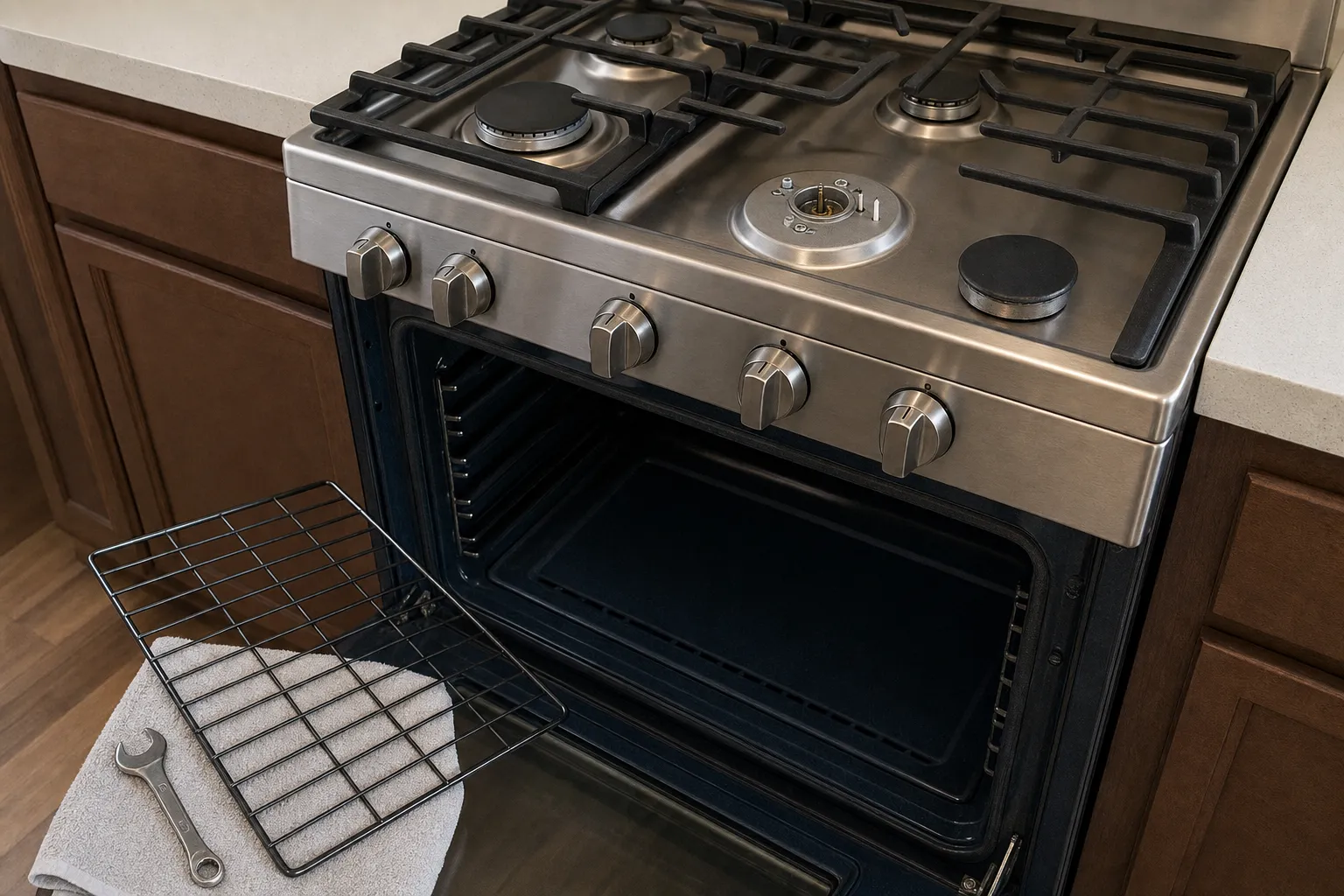
Wolf Range Repair
Wolf Gas Burner Clicks But Will Not Light: Work It Out in Order
A Wolf sealed burner that sparks endlessly without catching is usually a wet igniter, a burner cap sitting proud, or a blocked port — rarely the spark module everyone reaches for first. Here is the order to check.
- Written by
- Greg Lindqvist
- Trade
- Cooking-appliance technician — gas ignition and burners
- Years at it
- 18
- Page dated
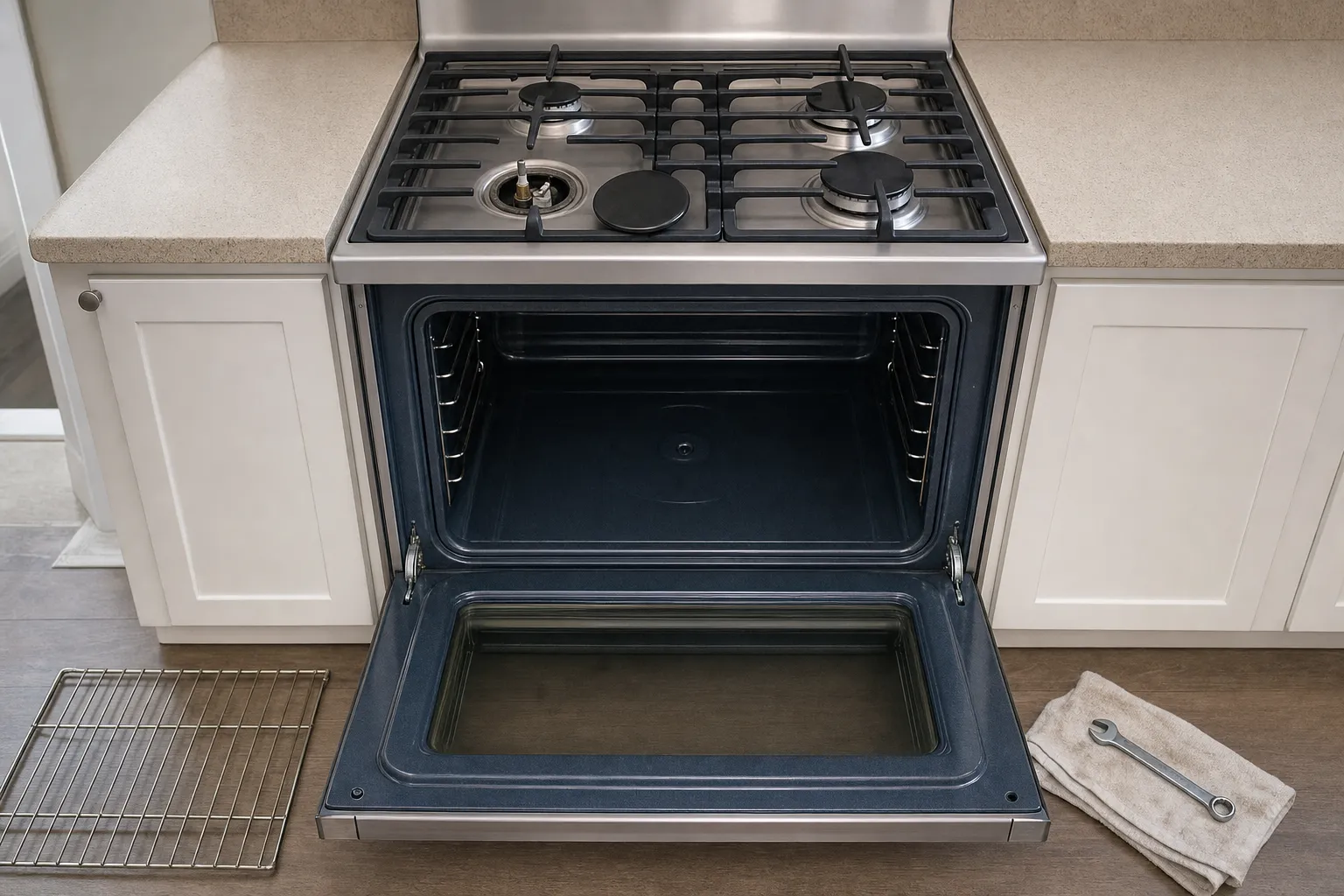
The sound is unmistakable: the knob goes to HI, the electrode ticks away happily, and nothing happens. Or it catches after eight seconds with a small thump that makes everyone in the kitchen flinch. On Wolf sealed burners this is a genuinely common call, and the good news is that the fault is usually at the cheap end of the parts list rather than deep in the range.
The clicking itself is a useful signal. It tells you the spark module has power, the switch in the knob is closing, and the electrode is firing. Three things you no longer have to test. What remains is whether gas is arriving at the port, and whether the spark is landing where the gas actually is.
Start with the burner cap, because it is nearly always the burner cap
Wolf sealed burners are built as a stack: base, burner head with the ports machined into its rim, and a cap that sits on top. That cap has to sit dead flat and fully seated. If it is rotated slightly, sitting on a crumb, or was put back a few millimetres out after a clean, the flame path from the port to the electrode gets disrupted and the spark fires into a space with no gas in it.
Lift the cap off while the burner is cold. Look at the underside — it should be flat and clean, with no carbon ridge. Look at the seat it drops onto. Put it back and rotate it gently until it drops the last fraction and stops moving. A cap that rocks, or that you can spin freely, is not seated.
This one fix accounts for a large share of the calls we take on this symptom, particularly in the week after a deep clean. It costs nothing and takes a minute.
Wet or fouled ignition after cleaning or a spill
The second most common cause is moisture. Water sitting in the electrode well, under the cap, or wicked into the ceramic insulator will bleed the spark to ground before it can jump the gap to the burner. You still hear clicking — the module is doing its job — but the energy is going somewhere useless.
If the range has been cleaned, or something boiled over, leave the burner apart and dry for several hours. A fan pointed at it speeds this up considerably. Do not use a heat gun on the ceramic.
While it is apart, look closely at the electrode itself. The ceramic should be clean, unbroken and free of hairline cracks. A cracked insulator earths the spark permanently and produces exactly this symptom with no moisture involved at all. The tip should sit where it sat when the cooktop was new, close to the burner rim without touching it. Bent electrodes happen when a pan is dragged across the top; leave the bending back to a technician, because the ceramic cracks easily.
Blocked ports and what a bad flame looks like
If the cap is seated and the ignition is dry, look at the ports. Wolf machines them finely, which is what gives the tight blue flame, and it also means a small amount of carbonised spillage blocks them properly. If only part of the ring lights, or the flame lifts away from the burner and dances, the ports are partially obstructed.
Clear them with a stiff bristle brush and, for individual ports, a straightened paperclip or a wooden toothpick. Never a drill bit or a needle file — enlarging a port changes the gas-to-air mixture permanently and gives you an orange, sooty flame that will mark every pan you own.
While you are there, note the flame quality on the burners that do work. A correct flame is tight, blue, and sits down on the port with a small inner cone. Orange tips, lazy movement or yellow through the body all point at mixture or supply problems that affect the whole manifold, and that is a different diagnosis to a single stubborn burner.
When it is genuinely the gas supply
If several burners are slow to light rather than one, stop looking at the burners. That pattern points upstream: a partially closed supply valve behind the range, a kinked flexible connector after the appliance was pushed back into the cabinet, or a regulator that is not delivering the right manifold pressure.
That last one is not a homeowner job. Manifold pressure is measured at a test port with a manometer, against the figure Wolf gives for that model and gas type, while other burners run to load the supply. Getting it wrong in either direction is a safety issue, and adjusting a regulator by feel is not a thing anyone should do.
The other clue is a range that was recently moved, delivered, or converted between natural gas and LP. Conversions that were done without changing every orifice show up as burners that light poorly, burn yellow, or will not stay lit at a low setting.
When to stop and call someone
Two situations end the DIY path immediately. The first is any smell of gas that is not right at the burner during a lighting attempt — that means ventilate, do not operate switches, and call. The second is a burner that lights with a delayed thump after several seconds of gas accumulating. That is a small deflagration, it is telling you the ignition is unreliable, and it should not be lived with.
Short of those, the sequence above resolves most cases in a Redmond kitchen without a part being ordered at all. Reseat the cap, dry the ignition, clear the ports, check the supply. If the burner still refuses after that, the fault has moved to the spark module, the switch in the knob, or the burner’s own gas valve, and those want a meter and a manometer rather than another guess.
Common follow-ups
Is it safe to keep trying a burner that clicks and will not light?
For a short try, yes. Wolf gives its surface burners about three to four seconds to catch. If nothing has caught after ten seconds, knob back to off; give the gas a minute to disperse before the next try. If you smell gas anywhere away from the burner, stop, get everyone out, and phone the gas utility or 911 once you are outside.
Why do other electrodes click when only one burner is turned on?
It depends on the model, so start at the rating plate. On the ones wired that way, several electrodes ticking while one burner lights is how they work, and it stops once that burner catches. Clicking that carries on after the flame is steady, or starts with every knob off, is a fault on any Wolf and worth a call.
Does a clicking burner mean the spark module has failed?
Rarely. A failing module tends to show as no spark anywhere, or sparking that will not stop. A burner that sparks normally but will not light points at the burner itself: a cap sitting out of place, damp around the electrode, or ports clogged with spill. Those sit at the cheap end of the list.